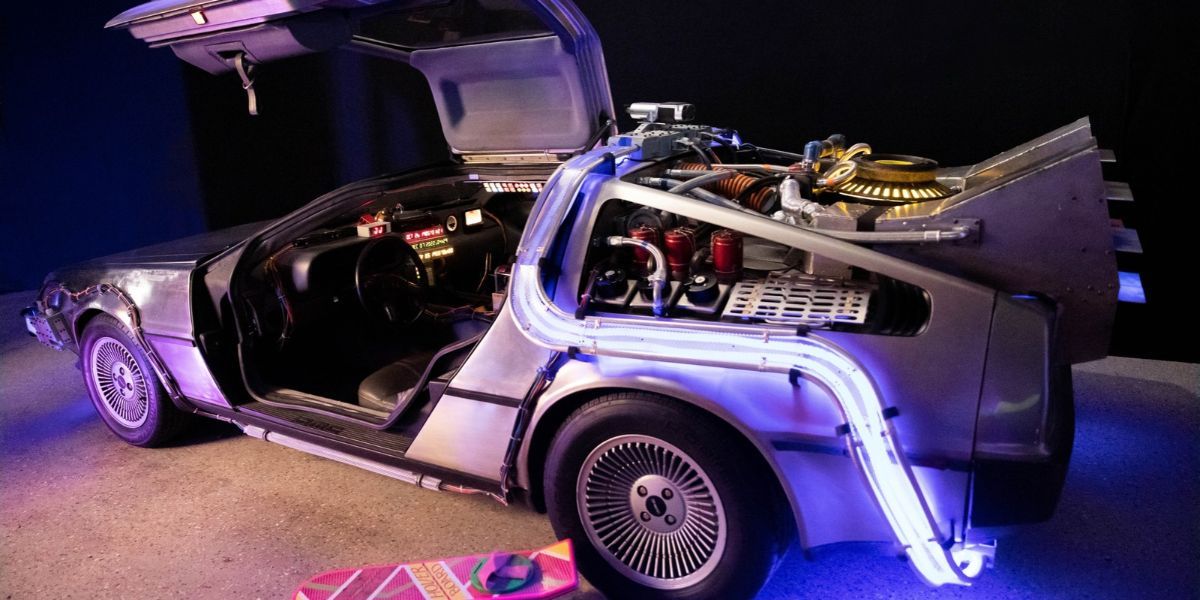
It’s been 35 years since Back to the Future Part II hit cinemas, and it might surprise you that it got quite a few predictions right!
Released in 1989 as a sequel to Back to the Future, it picks up after the events of the original film, with Marty McFly and Doc Brown travelling to the futuristic world of 2015 to prevent a family crisis. But when the time-travelling DeLorean falls into the wrong hands, their actions create an alternate 1985 where corruption and greed have transformed Marty’s hometown. To set things right, Marty and Doc must race across multiple timelines, revisiting key moments from the first film as they try to restore history before their future changes forever.
Now we’re well past 2015 in real life, but are we past the tech featured in the movie? Let’s take a look back at the tech featured:
“Roads? Where we are going we don’t need…roads…”
Well, we (Kinda) have flying cars,
Elon Musk recently showed off the new Roadster, an extreme, performance-focused sports car designed to blur the line between road vehicle and aerospace technology. Built with lightweight magnesium, titanium, and carbon fibre, it combines active aerodynamics, powered wings, and a multi-mode fan system that generates immense downforce, even when stationary. Its sleek exterior includes concealed headlights, flush surfaces, ultra-light wheels, and a durable aerospace-inspired finish. At the same time, the minimalist cockpit uses weight-saving design choices and high-grip materials to maximise driver control. Most remarkably, the Roadster’s advanced cold-gas thrusters can make split-second adjustments to improve stability, creating a vehicle engineered to respond almost instantly to driver inputs and push beyond the limits of conventional automotive performance.
Movie number 19
While Back to the Future Part II famously imagined a future featuring Jaws 19, movie franchises stretching far beyond a handful of sequels isn’t nearly as far-fetched!
Today, major franchises have grown into sprawling entertainment universes: Star Wars has more than a dozen films and numerous television series, the Marvel Cinematic Universe has nearly 40 movies alongside a growing catalogue of streaming shows, and Star Trek spans decades of films and television. While we may not have an actual Jaws 19, modern audiences have grown accustomed to franchises that span generations through sequels, prequels, spin-offs, and TV tie-ins. So much so that even picking a few examples to write about was a struggle, as so many movies do it now.
Holograms
The shark from JAWS 19 jumps out as a hologram, scaring Marty, Today, holograms are used more commonly.
Some airports use signage that appears to float in space; its effectiveness is… questionable, but it’s a start! Airports, hotels, train stations, meuseams and arenas are also useing holigrams of staff providing advice.
Billboard installations in places like NYC can now create the illusion of objects bursting out of screens. Not quite the same as a 3D shark moving in our real space.
Holograms are also used during live shows to memorialise performers who have passed away, with artists like Tupac Shakur famously appearing as a hologram after his death. At the same time, tribute events brought Punjabi rapper Sidhu Moosewala to the stage through holographic technology, attracting thousands of fans.
At the Sphere Las Vegas, a massive spherical entertainment venue is covered in high-resolution LED screens that can display realistic 3D visuals visible from miles away. Artists performing inside the venue use its wraparound display to create immersive environments that place audiences inside everything from outer space and underwater worlds to giant animated landscapes. The Sphere’s ability to surround concertgoers with enormous, lifelike imagery has been compared to the futuristic digital advertising and entertainment imagined in the film, showing how far visual technology has advanced since 1989.
The everyday stuff
While it’s fun to look back on the extreme tech, it’s also worth noting how many everyday technologies the movie got right. Voice-activated assistants, video calling, smart home devices, and connected kitchen appliances are now part of daily life for millions, proving some of the film’s futuristic ideas weren’t so far-fetched after all. While we might not have Jaws 19 leaping out of a holographic billboard just yet, Back to the Future showed that the future isn’t always about the most extreme inventions. Sometimes it’s the technology we quietly use every day that ends up being the most impressive prediction of all.
Everyday tech is growing at a rate never seen before, with more and more movie like gadgets being made everday, Soon even movies won’t be able to keep up.